
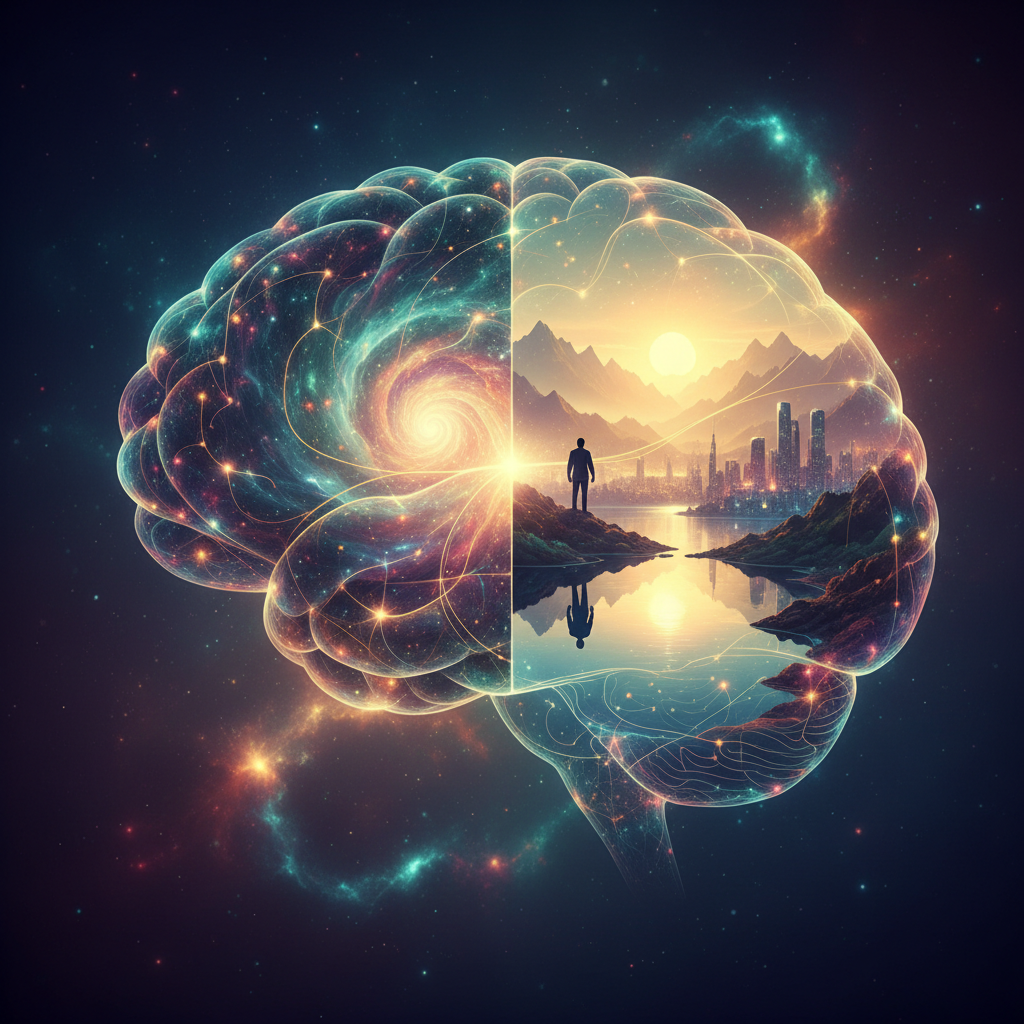
We often hear advice to 'visualize success' or 'imagine your goals.' It’s a common thread in personal development, and for good reason: studies on mental rehearsal and imagery have consistently shown its impact on performance, well-being, and even physical recovery. But what exactly does effective visualization look like? Is there a difference between a vague wish and a deeply felt, multi-sensory mental experience?
As someone who's spent years exploring the nuances of mindful practice and the power of our internal narratives, I’ve come to appreciate that the brain isn’t just looking for a general direction; it thrives on a blueprint. And that blueprint is built not with abstract concepts, but with rich, present-tense scenes.
The Brain's Preference for Specificity
Think about the difference between telling a friend, "I want to be happier," versus describing a specific moment: "I'm sitting on my porch swing, the morning sun warm on my face, a gentle breeze rustling the leaves, and I'm sipping my coffee, feeling completely at peace." The latter evokes an immediate, visceral response, doesn't it?
Our brains are incredibly efficient pattern-matching machines. When we offer it an abstract goal – like 'financial freedom' or 'better health' – it has to work harder to fill in the blanks. It’s like being given a destination without a map. But when we offer a detailed, present-tense scene, we’re providing a rich tapestry of sensory information that the brain can more readily process and even begin to simulate.
This isn't just poetic license. Research in neuroscience suggests that when we vividly imagine an action or experience, many of the same neural pathways activate as if we were actually performing or experiencing it. The more specific, multi-sensory, and emotionally resonant that mental imagery is, the more robust this neural activation becomes. It's as if we're giving our brain a dress rehearsal, preparing it for the real performance.
Beyond Sight: Engaging All Your Senses
Often, when we think of visualization, we default to visual imagery. While seeing is powerful, it’s only one facet of our experience. A truly impactful 'dream scene' engages all available senses.
Consider what it feels like to be in your desired future. What do you hear? Is it the murmur of conversation, the gentle lapping of waves, the hum of a successful project? What do you smell? Fresh-baked bread, pine needles, a new book? What do you feel? The texture of a fabric, the warmth of a handshake, the solid ground beneath your feet? And what are you doing? Are you speaking, writing, creating, connecting?
When you record these scenes in your own voice, focusing on the present tense – "I am feeling," "I am seeing," "I am hearing" – you're not just recalling a memory; you're actively constructing a future memory. The act of speaking it aloud, hearing your own voice describe this vivid reality, adds another layer of sensory input and reinforces the present-tense framing. This daily, active reconstruction can significantly deepen the neural pathways associated with that desired future.
The Emotional Anchor: Why Feelings Matter
Specificity isn't just about sensory detail; it's also about emotional resonance. An abstract goal might logically appeal to us, but a vivid dream scene can make us feel the joy, peace, accomplishment, or security we desire. These emotions act as powerful anchors.
When you describe your dream scene, pay attention to the feelings it evokes. "I feel a deep sense of calm washing over me." "My heart swells with gratitude." "A wave of confident energy courses through me." These emotional anchors are what truly motivate us and guide our actions, often subconsciously. They create a powerful feedback loop: the more we feel the emotions of our desired future, the more our brain is primed to seek out and create experiences that align with those feelings.
Regularly replaying these emotionally charged, present-tense scenes is akin to tending a garden. Each replay is a gentle watering, nurturing the seeds of your desired reality. It keeps the blueprint fresh in your mind, strengthens the emotional connections, and subtly, but powerfully, directs your focus and actions throughout your day.
In essence, moving from abstract goals to detailed, multi-sensory, emotionally anchored dream scenes isn't just a mental exercise; it's a profound shift in how we engage with our aspirations. It's about giving our incredible brains the precise, rich data they need to start building the future we truly desire, one vivid, present-tense moment at a time.