
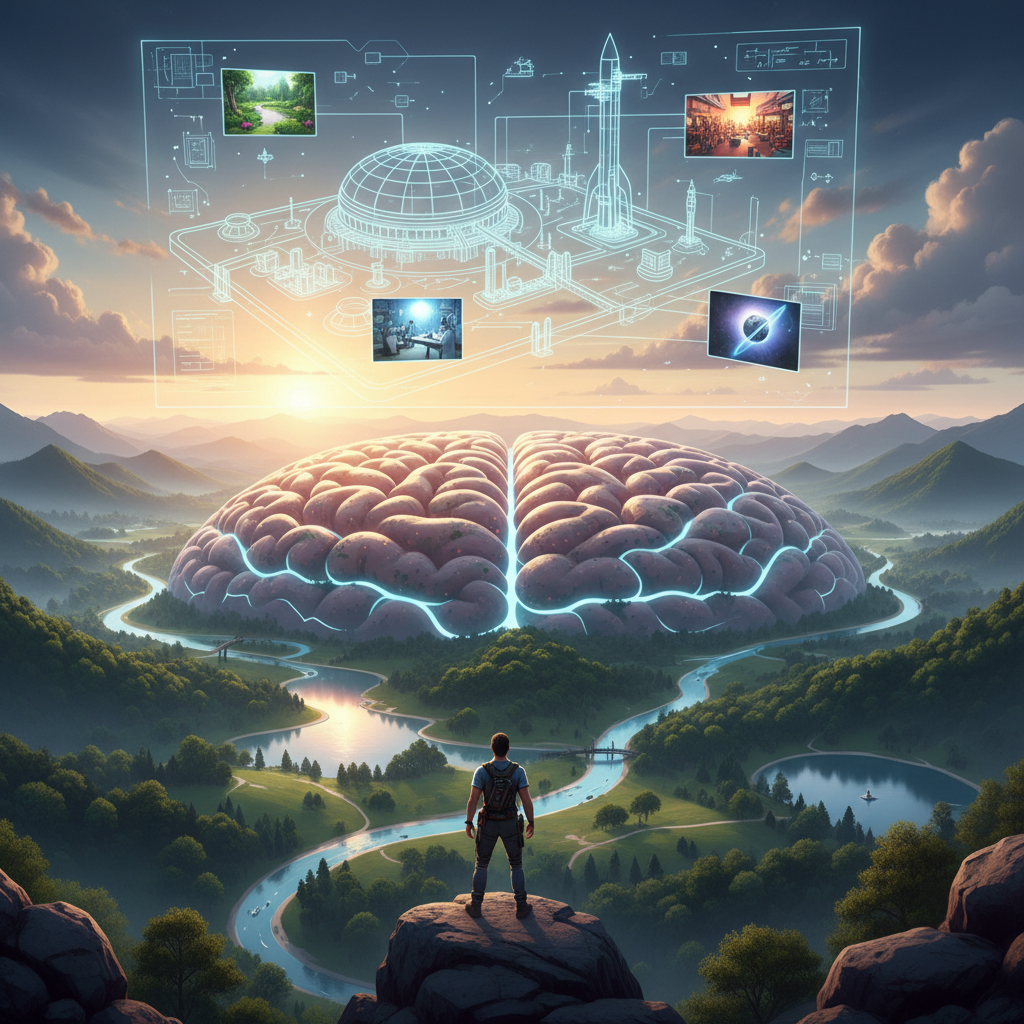
Have you ever noticed how some people seem to effortlessly move towards their aspirations, while others, despite their best efforts, feel stuck in a loop of wishing? Often, the difference lies not in the size of the ambition, but in how that ambition is presented to the mind.
We hear a lot about visualization, and for good reason. Studies on mental rehearsal and cognitive simulation consistently show that picturing an outcome can prime our brains for success. But there's a crucial distinction many miss: the difference between an abstract goal and a vivid, present-tense dream scene.
The Brain's Language: Specificity and Sensory Detail
Think about it. When you say, "I want to be successful," what does your brain actually process? It's a broad, nebulous concept. Success can mean a million different things. Your brain, in its incredible efficiency, struggles to create a concrete pathway to something so ill-defined.
Now, imagine instead: "I am sitting at my polished mahogany desk, the scent of fresh coffee lingering. The morning sun warms my back as I confidently sign the final page of a document, a sense of accomplishment swelling in my chest. My team is cheering softly in the background." Suddenly, your brain has something tangible to work with. It can almost feel the sun, smell the coffee, hear the cheers.
This is the core principle: your brain doesn't just process words; it creates internal simulations. The more detail, the more sensory input, the more 'real' the simulation feels, the more effectively your neural pathways begin to lay down tracks for that reality. It's like giving your internal GPS precise coordinates instead of a vague region.
Beyond Just Seeing: Multi-Sensory Immersion
Many visualization practices focus primarily on visual imagery. While powerful, true immersion goes further. Our world is a symphony of senses, and our brains are wired to process all of them. To truly convince your subconscious that a desired future is not just possible but imminent, engage as many senses as you can:
* Sight: What do you see? Colors, textures, light, expressions.
* Sound: What do you hear? Voices, music, nature, the hum of activity.
* Smell: Are there any distinct aromas? Coffee, fresh air, a particular perfume?
* Touch: What do you feel? The warmth of sun, the texture of fabric, a handshake?
* Taste: Is there anything you're tasting? A celebratory drink, a comforting meal?
And perhaps most importantly, Emotion. How do you feel in this scene? Joy, peace, confidence, gratitude? Anchoring these positive emotions to your dream scene is critical. Emotions are powerful motivators and memory enhancers. When you feel the emotion of achievement now, you're instructing your brain to seek out experiences that generate that feeling.
The Power of the Present Tense and Your Own Voice
When we describe our goals in the future tense – "I will be successful" – our brain places it in some distant, undefined future. It’s always going to happen, but never is happening. By framing your dream scenes in the present tense – "I am successful," "I am experiencing this" – you bypass this mental deferral.
This isn't about delusion; it's about programming. You're creating a mental blueprint that your subconscious can actively work towards, right now. It's the difference between saying "I'll start exercising tomorrow" and "I am feeling energized from my run right now."
And when these present-tense scenes are spoken aloud, in your own voice, something even more profound occurs. Your voice carries unique resonance and authority for your own brain. Hearing your own affirmations, your own vivid descriptions, reinforces the message in a deeply personal way. It transforms an abstract thought into an undeniable internal reality, a daily reminder from your most trusted source: yourself.
By regularly revisiting these rich, multi-sensory, present-tense scenes, you're not just wishing; you're actively building the neural pathways that will lead you to that desired reality. You're giving your brain the precise, vivid blueprint it needs to start constructing your future, brick by emotional brick.